Melbourne’s Suburban Rail Loop (SRL) has been promoted as a transformative investment in public transport—an orbital railway designed to connect middle-ring suburbs, relieve pressure on the CBD, and reshape how people move around Australia’s fastest-growing city. Yet behind the political optimism lies a growing debate about affordability, economic value, and long-term financial risks.
Let’s explore the suburban rail loop cost, the evolving cost estimates, and the rising concern that Melbourne’s largest infrastructure project may become a multigenerational financial burden. With costs significantly exceeding early projections, delays mounting across all sections—SRL East, SRL North and SRL West—and increasing scrutiny from agencies such as the Victorian Parliamentary Budget Office, Infrastructure Victoria, the Victorian Auditor-General and the federal government, Victorians are beginning to question whether the Suburban Rail Loop remains viable.
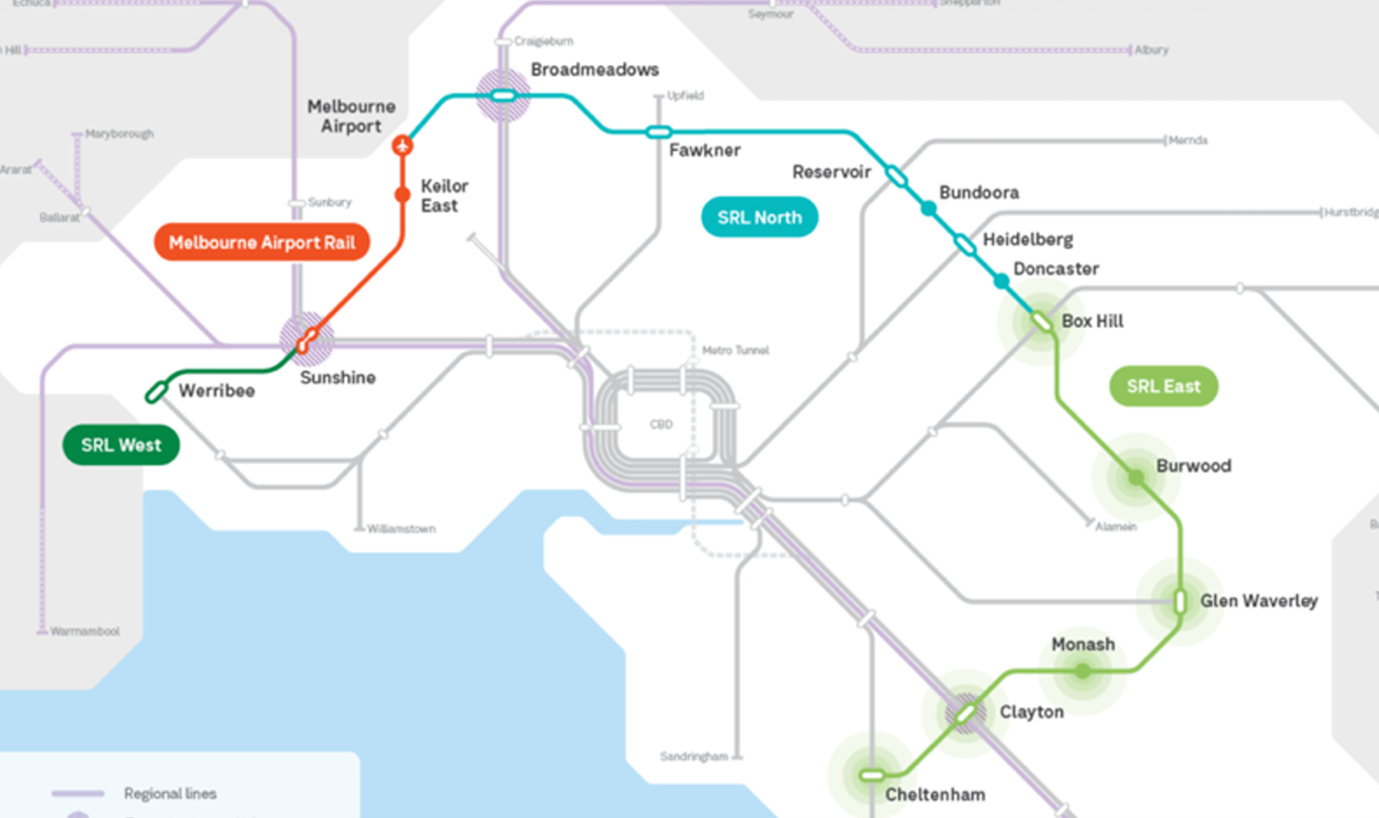
The SRL Cost: A Grand Vision With an Expanding Price Tag
When first announced, Melbourne’s Suburban Rail Loop was billed as a once-in-a-century infrastructure project that would revolutionise movement across the city. The concept was simple: create an orbital rail line linking major suburban activity centres, reducing dependence on radial train lines and providing faster, more direct journeys between key hubs.
The early cost projection widely communicated to the public was around $50 billion. While high, the estimate seemed plausible for a project of this scale. But as design work progressed and more details emerged, the financial picture changed dramatically.
Updated SRL Cost Estimates Reach New Territory
The Parliamentary Budget Office has since revised its forecasts, estimating that building and operating SRL East and SRL North over 50 years will cost at least $216 billion. When adding the anticipated costs of SRL West, and the associated rail connection to Melbourne Airport, the total rises even higher.
Major estimates now include:
- SRL East + SRL North: ~$216 billion
- Melbourne Airport Rail: ~$13 billion
- SRL West (Werribee to the Airport): ~$8 billion or more
- Total estimated cost today: ~$223 billion
- Projected long-term cost with inflation: >$400 billion.
These numbers place the Suburban Rail Loop among the most expensive transport projects in the world relative to Melbourne’s population.
What Will Victorians Get—And When—from the Suburban Rail Loop Cost?
While the magnitude of spending has increased, the delivery timeline has stretched. Critics argue that the mismatch between massive costs and slow delivery intensifies the financial concerns associated with the project.
Current projections indicate:
- SRL East: around 10 years to complete, if construction progresses on schedule.
- SRL North: not expected to be in service for roughly 30 years.
- SRL West: no firm timeline or commencement date.
- Melbourne Airport Rail: delayed after funding disputes between the Victorian Government and the Australian Government.
If these projections hold, much of Melbourne may wait decades for the promised full orbital line. Some Victorians in outer-west suburbs may never see the loop reach their communities. This extended delivery horizon intensifies the debate around whether the enormous upfront investment actually aligns with realistic public benefit.
The Debt Shadow: How SRL Spending Compounds State Finances
One of the most pressing issues surrounding the Melbourne suburban rail loop cost is the impact on Victoria’s already-strained finances.
Consider the broader debt context:
- Victoria currently holds one of the largest state-level debts in Australia.
- Total government debt is forecast to climb toward $200 billion in the near term.
- Interest repayments exceed $20 million per day.
- Future budgets will strain under increased borrowing costs, especially if global interest rates continue rising.
Adding a multi-hundred-billion-dollar project into this financial environment significantly heightens risk. Economists note that Victoria is already spending billions annually just to service existing debt—before a single commuter rides a train on SRL East, SRL North, or SRL West.
The growing financial exposure creates a substantial risk assessment challenge for the State. Each new contract further locks Victoria into long-term repayment obligations, reducing fiscal flexibility for decades.
The Role of Melbourne Airport Rail in the SRL Debate
Another layer of complexity involves the relationship between SRL and Melbourne Airport Rail. While both aim to improve transport connections, their planning and delivery timelines are intertwined and sometimes contradictory.
- The Victorian Government and the Australian Government jointly fund Melbourne Airport Rail.
- Investment delays have emerged after disagreements about route alignment and construction impacts.
- Sections of SRL North overlap with the Airport Rail corridor, raising questions about duplication and cost efficiency.
Some transport experts argue that Melbourne Airport Rail could deliver more immediate benefits at a far lower cost than the Suburban Rail Loop, especially if alternative, less expensive alignments were explored.
Missing Transparency and Cost–Benefit Analysis Problems
Effective infrastructure planning requires robust economic evaluation. Major agencies—such as Infrastructure Victoria, the Victorian Parliamentary Budget Office, and the Victorian Auditor-General—use cost–benefit analysis to assess whether public transport investments deliver sufficient value for money.
In the case of the Suburban Rail Loop:
- No complete, publicly released cost–benefit analysis exists for the full SRL program.
- SRL East has been estimated to return significantly less economic value than its cost.
- SRL North and SRL West lack detailed, transparent assessments.
- Governance processes and contract disclosure have been limited.
Without clear economic modelling, it becomes increasingly difficult for Victorians to evaluate whether the benefits justify the multibillion-dollar commitment. The scarcity of transparent analysis reinforces concerns about project feasibility and accountability.
International Borrowing Risks and Long-Term Exposure Resulting from the SRL Cost
As Victoria’s debt rises, the State may become increasingly reliant on international lenders. This introduces potential geopolitical and macroeconomic vulnerabilities.
Key issues include:
- Foreign lenders may impose higher interest rates due to perceived risk.
- Australia’s broader economic position does not shield Victoria from state-level credit downgrades.
- Global financial conditions could drastically change within SRL’s multi-decade construction timeline.
Credit rating agencies have already warned about Victoria’s growing debt obligations. Should future assessments reflect increased exposure due to the Suburban Rail Loop, borrowing may become more expensive, compounding long-term fiscal pressure.
Given that the Suburban Rail Loop has no near-term revenue stream to offset costs, these risks affect every Victorian taxpayer.
Opportunity Cost: What Victoria Might Lose
The cost of suburban rail loop infrastructure must be evaluated not only by its direct expense, but also by what it displaces.
Every dollar dedicated to SRL is a dollar unavailable for other high-value projects such as:
- Upgrading existing public transport lines
- Improving regional rail reliability
- Building new schools and hospitals
- Expanding social and affordable housing
- Reducing TAFE and university funding pressures
- Strengthening the electricity grid
- Addressing climate-resilience infrastructure needs.
Opportunity cost is a fundamental element of responsible budget planning. When a single project consumes more than $200 billion, the trade-offs ripple across multiple generations.
What could we gain if the SRL were cancelled?
From 2026, the estimated cost of the Suburban Rail Loop is $6.06 billion per year. If the SRL were cancelled, these funds saved could be spent in other areas, such as healthcare, road maintenance and education.
- Healthcare – cancelling the SRL would fund between 6,734,007 and 9,324,009 hospital bed-days per year, or between 2,857,429 and 4,217,541 ambulance trips.
- Roads – by not spending $6.06 billion on the SRL each, 302,199 kms of regional roads could be repaired. The estimated backlog of regional roads in need of repair is 4975 kilometres, so the savings could cover this many times over, and also go toward metropolitan roads badly needing repair.
- Education – the savings gained by stopping the Suburban Rail Loop could fund between 52,701 and 60,606 classroom teachers in Victoria, or a pay rise between 105.7% and 121.6% for teachers in Victoria.
These potential ways of spending the savings are hypothetical, and funds could be spent where needed most across the board, including in areas such as law and order and vocational and higher education. Besides spending the money more wisely in other areas, the excessive tax and fee burden in Victoria could be reduced by cancelling the Suburban Rail Loop.
Contract Lock-Ins and the $6 Billion Cancellation Question
Observers have disclosed that cancelling certain stages of the project could cost around $6 billion due to pre-signed construction and procurement contracts. Such lock-ins raise governance questions about whether the State prematurely committed to work without releasing comprehensive business cases.
While $6 billion is substantial, critics contend that stopping the project now may prevent total future obligations of up to $300-$400 billion. Supporters argue that SRL is necessary to future-proof Melbourne as it grows toward 8 million people.
Ultimately, this becomes a strategic choice:
- absorb high short-term cancellation costs
or - commit Victoria to a megaproject with uncertain long-term economic return.
Assessing the SRL Through a Public Value Lens
Infrastructure is not only about engineering; it’s about producing widespread public value. When considering SRL East, SRL North and SRL West, several key questions emerge:
Does the SRL address pressing transport needs now?
Some critics say Melbourne already has significant short-term transport issues—overcrowded trains, bottlenecked tram corridors, and declining bus performance—that the SRL will not fix for decades.
Is the project scalable or modular?
Unlike many global rail solutions, SRL is not easily broken into smaller, self-contained units. This all-or-nothing approach heightens financial exposure.
Do forecast benefits match cost estimates?
With rising cost projections, benefit projections must rise as well. Yet this has not occurred.
Is risk adequately managed?
Agencies such as the Victorian Auditor-General emphasise transparent risk frameworks. SRL’s evolving cost, shifting timelines and uncertain funding structure complicate traditional risk assessment methods.
How the Federal Government Fits into the Picture of the Suburban Rail Loop Cost
The Federal Government plays a critical role in national infrastructure financing through grants, loans, and policy coordination. While Canberra has supported major Victorian projects—such as the Metro Tunnel and Melbourne Airport Rail—the Suburban Rail Loop has not received the same level of endorsement.
Some reasons include:
- The lack of transparent cost–benefit analysis
- Concerns about Victoria’s credit outlook
- Broader national infrastructure funding priorities
- Debates about whether the project aligns with the nationwide transport strategy.
Without strong federal support, Victoria may be forced to shoulder the majority of SRL’s financial burden alone.
Long-Term Sustainability and Intergenerational Impacts of the SRL Cost
Large infrastructure projects should distribute benefits across generations. However, they should not burden future generations with disproportionate costs.
If current estimates exceed $400 billion, future Victorians may face:
- higher taxes
- reduced future infrastructure investment
- limited public service funding
- constrained budgets for emerging challenges (healthcare, ageing population, climate resilience).
Moreover, SRL spans such long timelines that technological change—autonomous mobility, advanced bus rapid transit systems, or new rail technologies—could alter long-term transport needs before the project is completed.
Is There a More Cost-Effective Alternative?
Many transport planners argue that Melbourne could achieve much of the SRL’s orbital connectivity through less expensive modes. Options include:
- dedicated bus rapid transit corridors
- light rail expansion
- smart signalling upgrades
- surface-level heavy rail extensions
- enhanced cross-suburban express buses
These alternatives could be deployed faster, at a fraction of the cost, and still deliver high-value public transport benefits.
The Future of Melbourne’s Suburban Rail Loop
The debate over the suburban rail loop cost is far from over. On one end of the spectrum, supporters envision the SRL as a bold investment that positions Melbourne for long-term success. On the other, critics warn that the project risks becoming the most expensive public transport undertaking in Australian history, with uncertain returns and staggering financial consequences.
As the Victorian Government, the Australian Government, and independent oversight bodies continue to evaluate the project, several realities remain clear:
- Cost estimates have risen dramatically.
- Financial concerns are widespread across economic, political and community stakeholders.
- A lack of complete, transparent cost–benefit analysis limits informed public debate.
- The project’s scale creates an unprecedented long-term risk assessment challenge.
Ultimately, the future of Melbourne’s Suburban Rail Loop hinges on one question:
Do the benefits justify a potential multi-hundred-billion-dollar investment?
The answer will shape Victoria’s economic landscape for decades.
See our official policy on cancelling the Melbourne Suburban Rail Loop.